~ Laura Stemmle
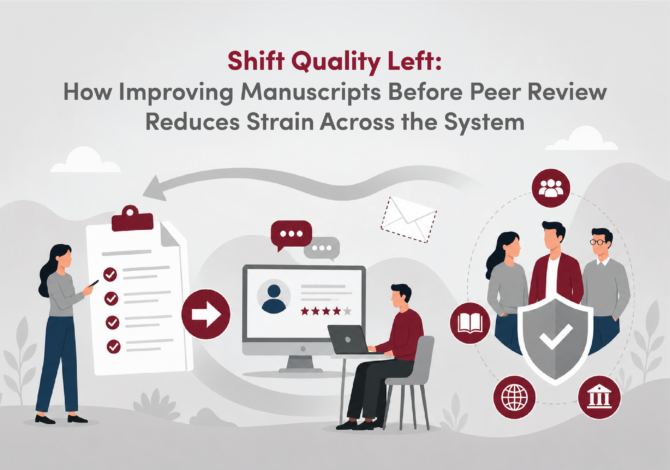
To “shift quality left” in scholarly publishing means moving manuscript quality checks, such as language editing and structural validation, to the very beginning of the submission stage. This upstream quality publishing model automatically fixes errors before peer review begins, which saves editor time, reduces peer review burden, and lowers production costs.
The scholarly publishing industry currently spends a significant portion of its budget on reactive solutions late in the publication process. However, many compounding problems originate upstream. By changing when we address these issues, we can transform the entire publishing lifecycle and relieve the intense pressure creating bottlenecks in the scholarly communication process.
Redirecting Submissions for Better Journal Fit
When considering how to improve manuscript quality before submission, the first fundamental question is whether the paper is at the right journal. A poor journal fit strains the editorial queue and wastes valuable resources on scope mismatch desk rejects. Instead of relying on manual triage, publishers can implement intelligent journal fit tools, like Journal Guide, to evaluate scope immediately upon submission.
By redirecting mismatched submissions to a better fitting journal within the publisher’s portfolio, editors recover valuable time and keep good articles from going to competitors. Catching this alignment issue early is the first critical step in scholarly publishing workflow automation. It ensures that subsequent investments in language quality academic submission checks and structural formatting are only spent on manuscripts that belong in that specific journal queue.
Overcoming the Language Quality Barrier
Language barriers frequently mask excellent research and increase the time editors spend on remediation. Addressing this requires robust publisher AI editing pre-peer review. For example, the Rubriq model provides a structured submission process with integrated AI intervention for language improvement. Built on 17 years of continuous editing automation by AJE, which has edited over one million scholarly manuscripts since 2004, this AI manuscript editing tool delivers an average edit speed of just one to two minutes per manuscript. It is crucial to note that this machine learning editing is not content generation. Instead, this AI-assisted manuscript quality check clarifies the author’s original intent. In a pilot program with 500 Chinese authors, providing automated language editing during submission improved acceptance rates by more than 50%. Clean manuscripts reduce the peer review burden, allowing reviewers to evaluate the actual research rather than correcting grammar.
Eliminating Metadata Loss Through Single-Source Publishing
The traditional content lifecycle is highly inefficient because metadata is repeatedly rekeyed throughout the journey. The solution is single-source publishing, a unified architecture that captures metadata once at submission to eliminate downstream rekeying. The core advantage of this XML-first journal workflow is that content is converted to XML automatically at submission, and all participants work on one live, synchronized version. Utilizing a collaborative digital editor in scholarly publishing removes handoff errors entirely. Platforms like HighWire’s DigiCorePro provide a drag-and-drop workflow builder that serves as an orchestration layer, allowing publishers to configure and combine tools directly at the point of submission while authors remain in a familiar authoring environment.
Traditional Workflow vs. Shift Quality Left Workflow
| Stage |
Traditional Approach |
Quality-Left Approach |
Outcome |
| Submission |
Manual intake, minimal validation, reactive checks. |
XML conversion at manuscript submission, AI language triage. |
Upstream quality investment prevents downstream errors. |
| Editorial & Peer Review |
High desk reject rate for language or fit, heavy peer review burden. |
AI editing pre-peer review, intelligent journal fit tools. |
Reduces peer review burden; reviewers focus strictly on science. |
| Production |
Repeated metadata rekeying, manual format conversions. |
Single-source publishing, structured XML flows directly through. |
Lowers publishing production costs; direct publish flow. |
Connecting the Framework for Lifecycle ROI
By moving quality investment upstream, the cumulative return on investment grows across the lifecycle because early quality investment prevents costly downstream rework. When a publisher invests in manuscript quality at submission, editors spend less time on remediation, reviewers receive cleaner papers, and production costs drop. A modular, API-driven platform enables publishers to plug in the quality and integrity tools they need without disrupting existing workflows.
In my recent session at the SSP 2026 Annual Meeting, we explored these workflow models in greater detail. For publishers looking to implement this practical framework, connecting language tools, intelligent editing, and modern infrastructure is the clearest path to reducing costs and improving outcomes across the lifecycle.
Frequently Asked Questions (FAQ)
- What does “shift quality left” mean in scholarly publishing?
It means moving quality checks like language editing, metadata validation, and formatting to the very beginning of the submission process before peer review starts.
- How does AI manuscript edit before peer review work?
Publishers use AI-assisted manuscript quality tools to automatically assess language and structure at submission. This provides necessary author manuscript feedback before peer review to ensure the paper is clear and readable.
- Why does manuscript quality at submission matter for publishers?
High manuscript quality at submission reduces editor workload, lowers the desk reject rate for technicalities, and significantly decreases publishing production costs.
- What are the benefits of single-source publishing?
Single-source publishing benefits journals by capturing metadata once, preventing rekeying errors downstream, and allowing the same structured content to flow from submission directly into production.
- How can publishers reduce peer reviewer burden?
By utilizing peer review efficiency tools that fix language and formatting upstream, reviewers can focus entirely on evaluating the scientific merit of the research rather than correcting grammar.
- What is XML-first or single-source publishing in journals?
It is a modern publishing workflow strategy where documents are converted to XML at submission, allowing all stakeholders to collaborate on one live, synchronized version throughout the entire lifecycle.
- What is upstream quality investment in academic publishing?
It is the proactive allocation of resources to improve manuscripts at the submission phase, ensuring early quality interventions that compound into massive time and cost savings downstream.